|
|
|
|
|
|
| 1. | The hoist shall be tested under load in lifting and lowering directions and the operation of the chain and sprockets shall be observed. The chain should feed smoothly into and away from the sprockets. |
| 2. | If the chain binds, jumps, or is noisy, it shall first be checked to ensure that it is clean and properly lubricated. If the trouble persists, the chain and mating parts shall be inspected for wear, distortion, or other damage. |
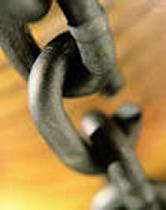
| 3. | The chain shall be examined visually for gouges, nicks, weld spatter, corrosion, and distorted links. |
| 4. | The chain shall then be slackened and the adjacent links moved to one side to inspect for wear at the contact points. |
| 5. | The chain should be measured according
to the hoist manufacturer's instructions. If instructions are not available,
the process shall continue as follows.
An unworn, un-stretched length of the chain shall be selected (e.g., at the slack end). The chain shall be suspended vertically under tension and, using a caliper-type gage, the outside length of any convenient number of links shall be measured (approximately 12 to 24 inches overall). The same number of links in the used sections shall be measured and the percentage increase in length shall be calculated.
|
| Hook Inspection |
|
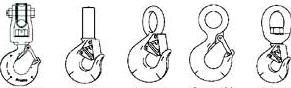
| 1. | Cracks, nicks, or gouges. |
| 2. | Latch engagement, damaged or malfunctioning latch (if provided) . |
| 3. | Hook attachment and securing means. |
| 4. | Deformation. Any bending or twisting exceeding 10 degrees from the plane of the unbent hook. |
| 5. | Throat Opening. Any distortion causing an increase in throat opening exceeding 15 percent. |
| 6. | Wear. Any wear exceeding 10 percent of the original section dimension of the hook or its load pin. |
| 7. | Non-Destructive Testing for surface or subsurface cracks. |

| Name | |
| Title | |
| Company | |
| Address | |
| Phone |
|
Questions or problems regarding this web site should
be directed to the
webmaster. |